
"Defend a creative direction with cultural evidence before our next review."
Open the composer →Antropomedia Express · How it works
Understand who your audiences are. Discover who they could be
A living encyclopedia of consumer culture, organized around the tribes people actually belong to. Here is the method, and where to begin.
Why tribes, and not demographics
The one idea that makes everything else in the platform make sense.
People do not behave as isolated individuals. They behave as members of tribes they want to belong to, distance themselves from, or perform for. A sociogram® analysis reveals those tribes from real network behavior: who follows whom, who interacts with whom, who recognizes whom. The clusters that emerge are post-demographic. They form around shared meaning, aesthetics, and motivation, not age or income brackets. Every one of the 650+ profiles in this encyclopedia is the output of that method.
To see why, follow one person. Ana is a single individual, the same in every frame below; only the method for placing her changes.
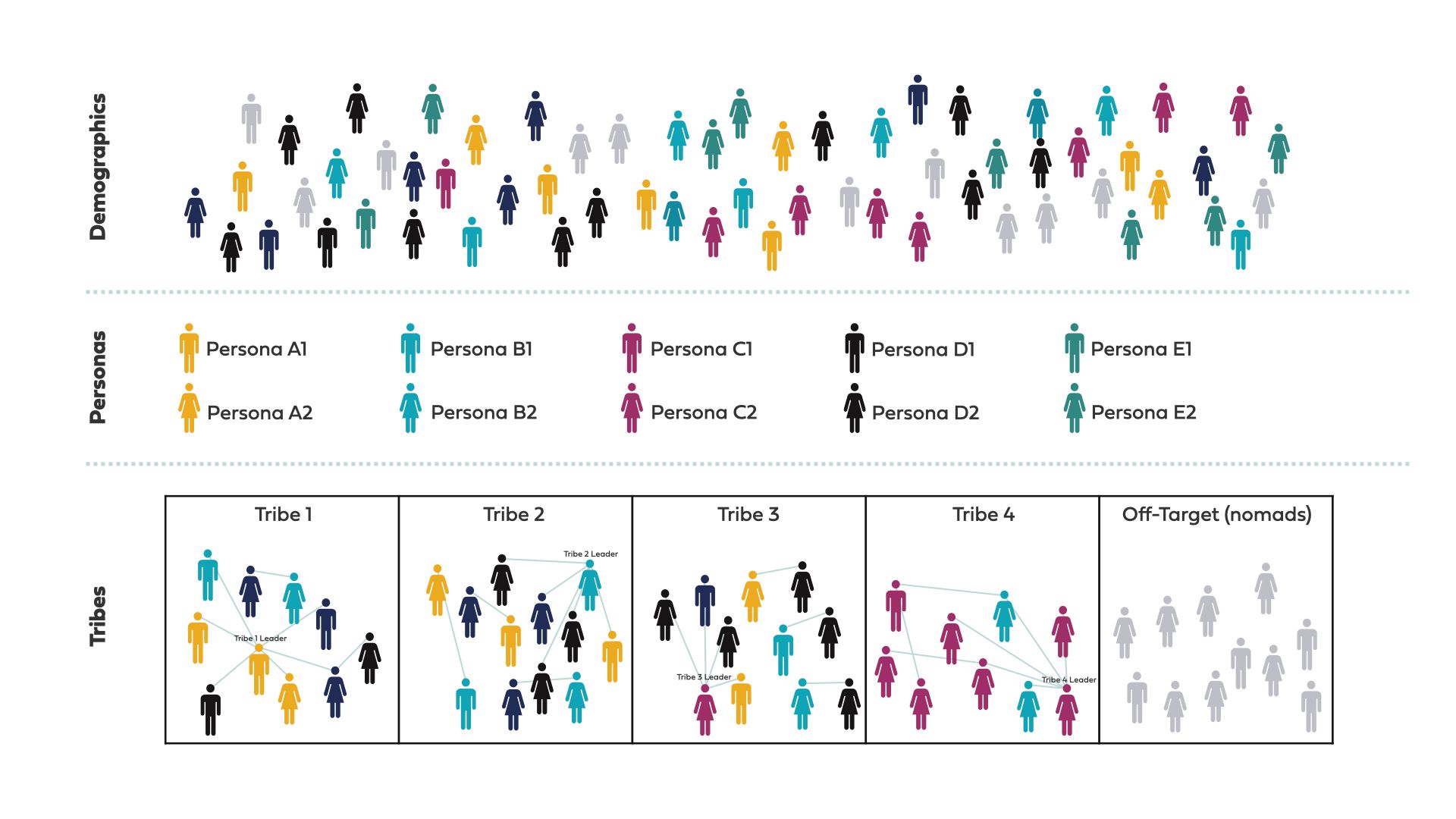
Start with one person. Ana is 32, urban, mid-income. Demographic segmentation files her by age, gender, income, and location: tidy, but it says nothing about what she wants.
Why personas fall short, and the sources behind it
Personas, even quantitative ones, tend not to size a market, can encode a team's own assumptions, drift from the business objective, and date quickly. Recent marketing scholarship also separates segmenting markets from describing idealized people, and points to behavioral and tribe-based methods as more measurable. The evidence behind this sequence:
Diaz Ruiz, C. A., & Kjellberg, H. (2020). Feral segmentation: How cultural intermediaries perform market segmentation in the wild. Marketing Theory, 20(4), 429-457. https://doi.org/10.1177/1470593120920330
Gloor, P. A., Fronzetti Colladon, A., de Oliveira, J. M., & Rovelli, P. (2020). Put your money where your mouth is: Using deep learning to identify consumer tribes from word usage. International Journal of Information Management, 51, Article 101924. https://doi.org/10.1016/j.ijinfomgt.2019.03.011
Hsu, P.-F., Lu, Y.-H., Chen, S.-C., & Kuo, P. P. Y. (2024). Creating and validating predictive personas for target marketing. International Journal of Human-Computer Studies, 181, Article 103147. https://doi.org/10.1016/j.ijhcs.2023.103147
Jansen, B. J., Jung, S.-G., Salminen, J., Guan, K. W., & Nielsen, L. (2021). Strengths and weaknesses of persona creation methods: Guidelines and opportunities for digital innovations. In T. X. Bui (Ed.), Proceedings of the 54th Hawaii International Conference on System Sciences (pp. 4971-4980). https://doi.org/10.24251/HICSS.2021.604
Salminen, J., Mustak, M., Sufyan, M., & Jansen, B. J. (2023). How can algorithms help in segmenting users and customers? A systematic review and research agenda for algorithmic customer segmentation. Journal of Marketing Analytics, 11(4), 677-692. https://doi.org/10.1057/s41270-023-00235-5
Syrjälä, H., Diaz Ruiz, C., Leipämaa-Leskinen, H., & Luomala, H. T. (2025). From consumers to consumption: The socio-technical assemblage of the persona in market segmentation. Journal of Business Research, 194, Article 115387. https://doi.org/10.1016/j.jbusres.2025.115387
Read across, not just down
The value is in the cross-referencing. Every tribe carries the evidence around it.
Consumer tribe
The Rewinders
A tribe built on nostalgia: people who find meaning in the analog past.
Open the profile →
Consumer statistics
Nostalgia, sized
The numbers that prove the demand a nostalgia strategy is built on.
See the statistics →
Case study
Budweiser
The tribe in action: a campaign that read the cultural moment correctly.
Read the case →
Start with one tribe and follow the threads outward. The same three content types connect across all 650+ profiles.
See what a Position looks like
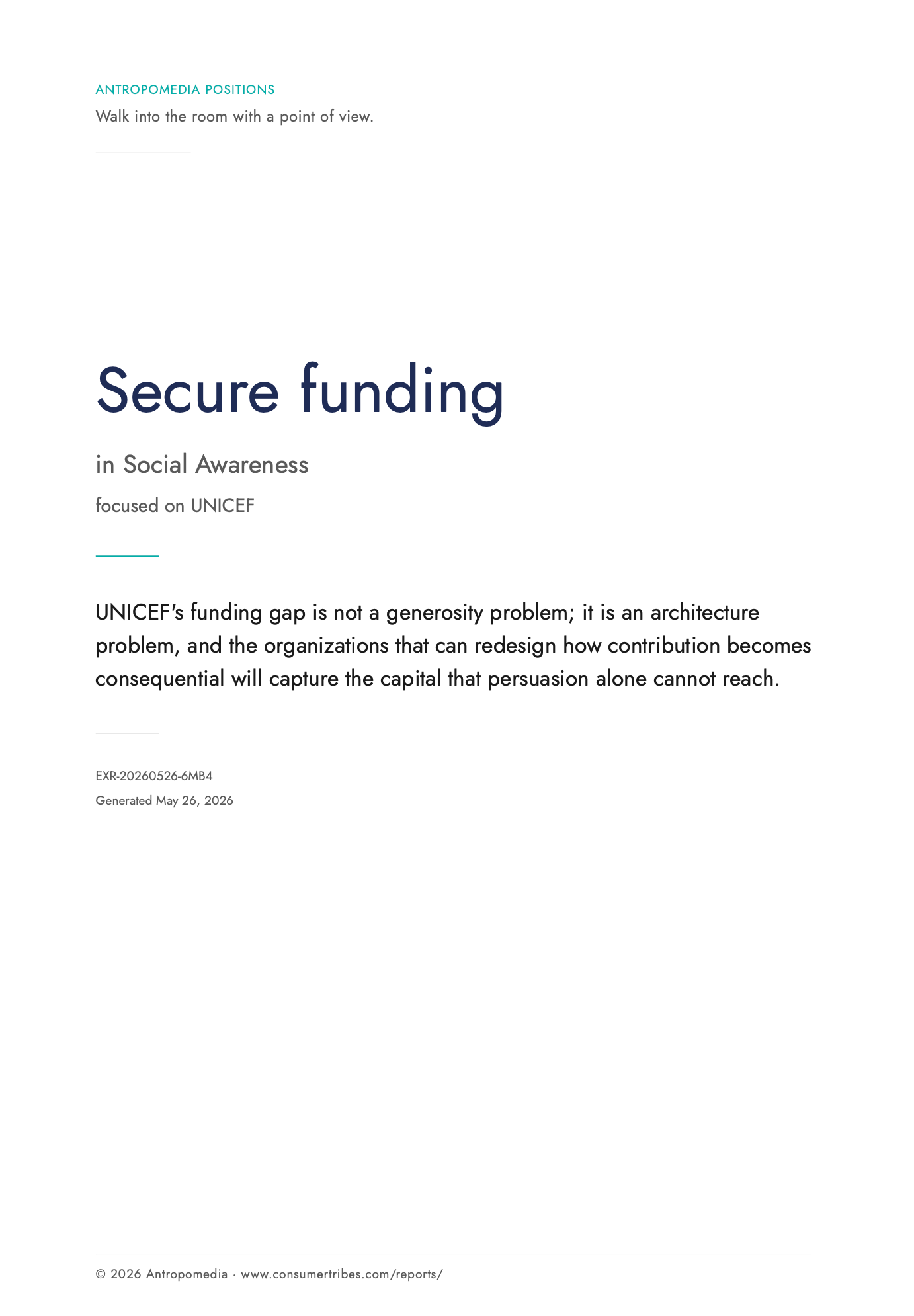
A five-to-seven-page editorial brief, composed from the corpus in about three minutes. It names the tribes to address, the cases to borrow from, the data that anchors the argument, and the moves to consider.
Your objective
You describe the decision in front of you, in plain language.
The corpus is consulted
Relevant tribes, statistics, and cases surface from vetted Antropomedia data, never the open web.
Your brief
A citable point of view, with every claim traceable to a source.
Three ways to start
"Find a cultural territory this brand can own that competitors have not claimed."
Open the composer →"Brief a team entering a new market on the tribes that matter there."
Open the composer →Inside the toolkit
Six assistants interrogate the corpus. Each works from vetted Antropomedia data, so every answer traces back to a source you can cite.
Find Your Tribe
Describe a vague audience and receive a tribe match with its cultural codes.
Open →Ask The Tribe
Get audience-style feedback and local nuance from a tribe's point of view.
Open →TribeScan
Upload campaign imagery for an On-Code and Off-Code reading across three dimensions.
Open →Get Stats
Pull the relevant statistics on demand, by category and geography.
Open →Bank of Innovation
Surface precedent cases with an anthropological reframe.
Open →Spark Ideas
Generate bold, culturally grounded ideas you can take into a workshop.
Open →Your home bases
Three places you will return to. The corpus grows daily across all of them.
Save as you go. The bookmark icon on any post keeps it in your sidebar for later.
Read your way. Four themes live in the left sidebar: Light, Whitesmoke, Dark, and Midnight.
Questions before you start
Write to support@antropomedia.com. Want to hear it from a member first? Our Ask Anyone policy connects you with a current client, no script and no sales pitch.
Start exploring
Understand who your audiences are. Discover who they could be.