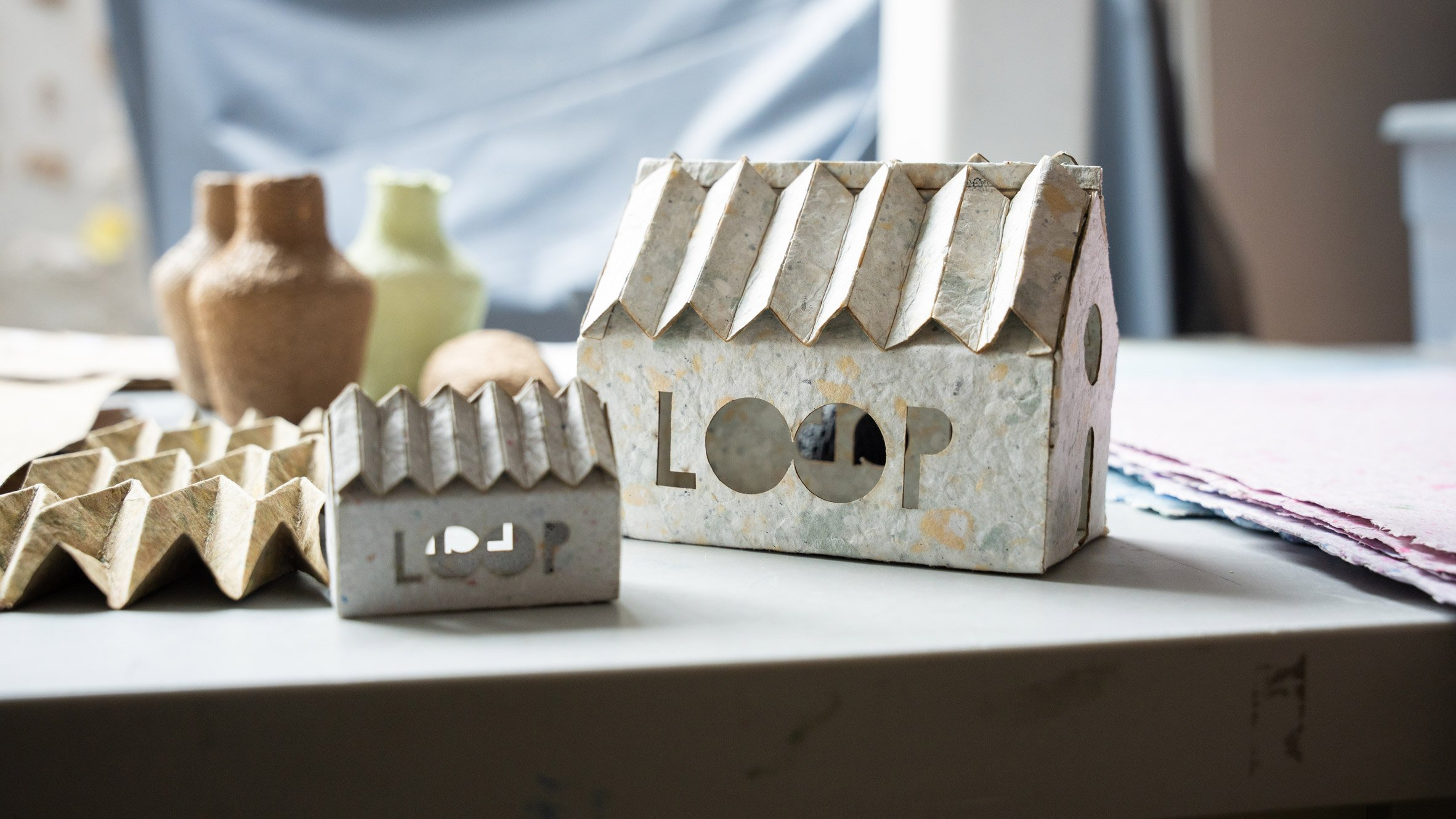
Loop Lab at RISD: Designing Circular Waste Infrastructures
The case concerns Loop Lab at the Rhode Island School of Design, a pilot initiative that re-routes the institution’s own waste streams into raw materials for design experimentation and production. Supported by grant funding and embedded within RISD’s Nature Lab, the project systematically collects by-products from studios, workshops, and campus operations; processes them into reusable feedstocks (such as pulp, aggregates, and bio-based matter); and reinserts them into curricular, research, and prototyping activities. Loop Lab thus acts as both an infrastructural node and a pedagogical device, making visible the flows, frictions, and potentialities of campus material ecologies.
Beyond its technical operations, Loop Lab functions as a cultural intervention into how designers, educators, and students conceptualize waste, value, and responsibility. It reframes the campus as a living laboratory of circularity where discarded materials become sites of inquiry rather than endpoints of consumption. By choreographing collaborations among facilities staff, faculty, and students, the project challenges linear economies of disposal and introduces new forms of institutional reflexivity around resource use, sustainability narratives, and design’s role in shaping socio-material futures.
Loop Lab can be read as a situated experiment in circular economy practice but also as a form of “infrastructural pedagogy” that reconfigures everyday relations between human actors, materials, and institutional routines. Instead of treating recycling as an invisible backend service, the project foregrounds waste as an epistemic object that organizes learning, affects, and ethical reflection. In doing so, it bridges digital and material domains: data about waste flows, material properties, and processing techniques becomes integral to studio decisions, enabling students to see design not as isolated artifact production but as participation in extended socio-technical assemblages. The lab recodes waste from abject remainder into speculative resource, illustrating how semiotic revaluation (what counts as “valuable material”) is co-produced with new infrastructures and practices. At the same time, Loop Lab exposes the limits of voluntaristic sustainability: without supportive governance, procurement changes, and long-term budgeting, such initiatives risk remaining exemplary islands rather than catalysts of systemic transformation.
Practical Implications for Organizations
- Treat waste streams as strategic assets by mapping them, quantifying their properties, and exploring in-house remanufacturing or creative reuse pathways.
- Build visible “circular hubs” (labs, spaces, or pilot lines) that allow employees and partners to experiment hands-on with discarded materials.
- Integrate waste and lifecycle data into design, R&D, and marketing workflows so circularity becomes a design constraint, not an afterthought.
- Formalize cross-functional alliances between operations, sustainability, and brand teams to align infrastructure changes with narrative and reputation goals.
- Use circularity pilots as cultural change devices: document stories, prototypes, and failures to cultivate new norms of responsibility and experimentation.
- Plan from the outset for scalability, including supplier engagement, regulatory compliance, and financial models that can extend beyond the pilot phase.
Consumer tribes that may relate to this case study:
 Eureka
 Eureka
 Eureka