Flushing Norms: How "Pee on a Plant" Reframed a Bodily Ritual as Environmental Action
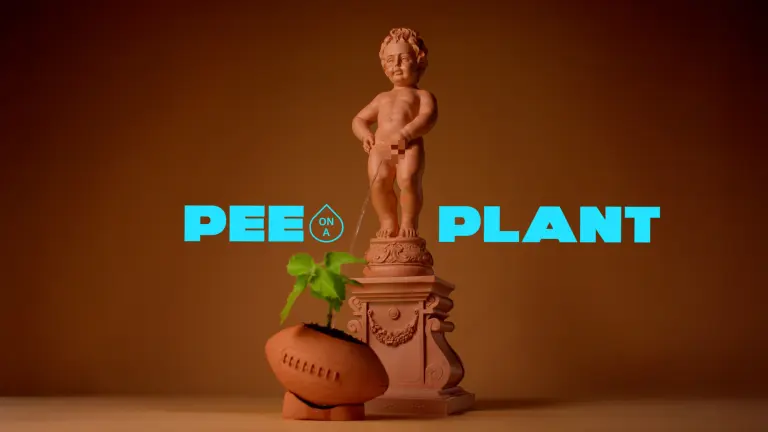
Every Super Bowl halftime triggers the so-called "Super Flush," a synchronized bathroom rush by over 120 million viewers that sends enormous volumes of potable water and nutrient-rich urine into overburdened wastewater systems within minutes. Developed by independent creative agency LERMA/ in collaboration with the Rich Earth Institute, the "Pee on a Plant" campaign reframed this mundane ritual as an environmental opportunity. Anchored at PeeOnAPlant.com, the initiative invited viewers to fertilize a plant instead of flushing, grounding its provocation in biochemistry: human urine contains nitrogen, phosphorus, and potassium—the very macronutrients commercial fertilizers deliver. For those without a nearby plant, the hub offered practical alternatives such as fixing leaks, installing water-efficient fixtures, or supporting the Institute's research.
The campaign's broader significance lies in its demonstration that cultural timing, scientific legitimacy, and transgressive humor can converge to shift deeply habitual consumer behavior. By attaching environmental meaning to a collective, predictable moment, LERMA/ and the Rich Earth Institute transformed passive spectatorship into participatory advocacy, challenging assumptions about what sustainability messaging can look like.
The campaign operates at the intersection of descriptive norm activation and injunctive reframing. Rather than lamenting the environmental damage of the Super Flush—a tactic that would inadvertently normalize the harmful behavior—the initiative redirected the descriptive norm itself, acknowledging that millions will act simultaneously while proposing an alternative action for that collective moment. This alignment avoids the well-documented boomerang effect in which publicizing undesirable prevalence reinforces the very conduct communicators seek to curtail. The humorous, deliberately provocative tone served a dual semiotic function: it disrupted habitual cognitive scripts surrounding bathroom behavior and generated organic social sharing, effectively converting audiences into distributors. The campaign also leveraged cultural event salience as a mnemonic anchor, linking the desired behavior to a highly specific, recurring temporal cue, thereby increasing the likelihood of norm retrieval in future analogous moments.
Practical Implications for Organizations
- Leverage cultural synchrony: Identify collective behavioral peaks—product launches, seasonal events—and attach prosocial messaging precisely at those inflection points.
- Reframe, don't shame: Avoid spotlighting the prevalence of undesirable behavior; instead redirect existing habits toward constructive alternatives.
- Pair science with humor: Transgressive creativity earns attention, but scientific grounding sustains credibility and conversion.
- Design mnemonic cues: Tie campaign messaging to recurring situational triggers so that norm recall extends well beyond initial exposure.
- Provide actionable alternatives: Always supply a spectrum of participation options to lower barriers and broaden audience engagement.
Consumer tribes that may relate to this Eureka:
 Eureka
 Eureka