Stream as Whisper-First Interface: Reframing Wearable Input and Everyday Cognition
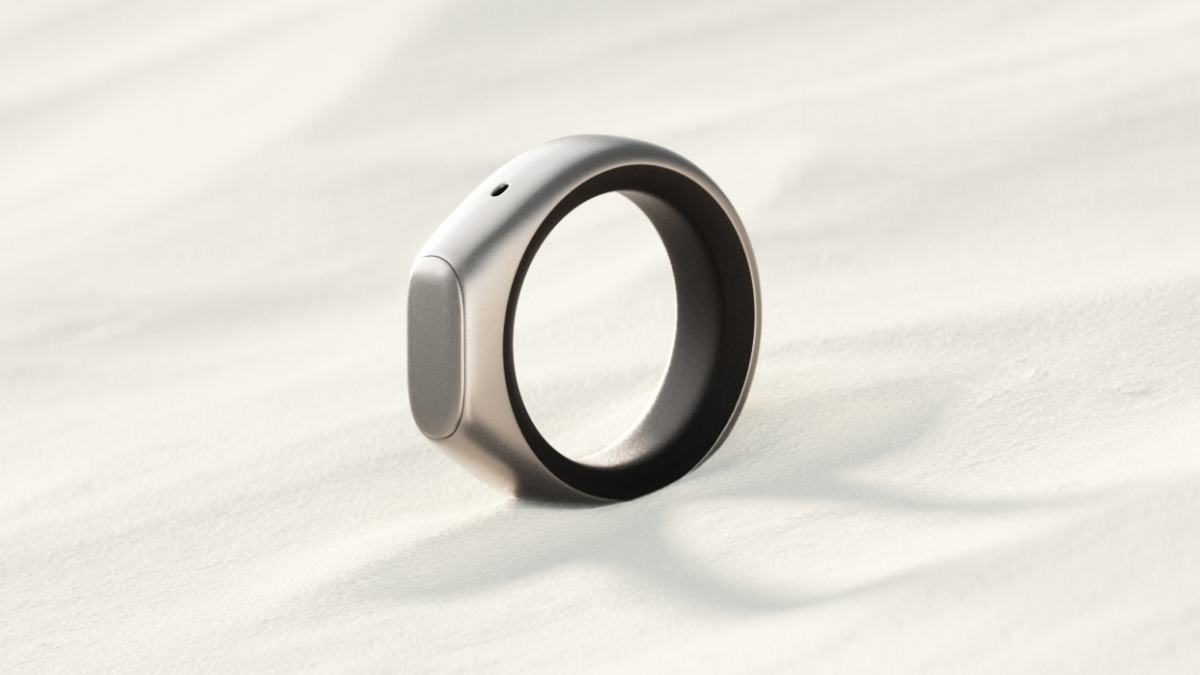
Sandbar’s Stream is a smart ring designed for the index finger that combines microphones with a touch-sensitive surface to capture short-form, whisper-level voice notes and control media. Activation occurs only during touchpad press, foregrounding user intention and minimizing ambient capture. A companion iOS app transcribes notes and offers an AI chatbot to structure, edit, and retrieve ideas. The same hardware affords gestural media control, enabling lightweight phone-free interactions. Developed by former Meta interface specialists, Stream positions itself as a “mouse for voice,” emphasizing precise, momentary input over always-on assistance.
The broader significance lies in shifting human–computer interaction from screen-forward to peripheral, embodied micro-interactions. Stream suggests a future of intimate, low-friction cognition support, where fragmented thoughts are externalized, indexed, and recomposed through on-device sensing plus cloud-based language models. It also exemplifies a contest over voice-AI form factors, privacy signaling, and social acceptability, revealing how wearables translate cultural norms—discretion, control, and minimality—into hardware-software assemblages.
Stream concentrates agency through tactile gating, aligning with participatory control norms that mitigate surveillance anxieties and “control creep.” The whisper-capture affordance reframes public speakability by enabling semi-private vocalization, altering context collapse in shared spaces. As an interface object, the ring enacts symbolic minimalism—status-neutral, jewelry-like—reducing stigma associated with head-worn mics while still performing computational labor. The paired AI functions as a cognitive scaffold that reorganizes fragments into projects, exemplifying distributed cognition and the commodification of personal ideation streams. By collapsing note-taking, search, and editing into a conversational loop, Stream narrows the gap between capture and meaning-making, yet it also risks habituating users to model-shaped memory practices. The design’s insistence on intentional press-to-record is semiotically potent; it communicates consent, foregrounds temporality, and modulates data granularity, which can build interpersonal trust and mitigate platform skepticism. Competition in ring-based voice hardware highlights market-level isomorphism: firms converge on discreet, glance-free inputs to re-own moments currently monopolized by smartphones.
Practical Implications for Organizations
- Design for intentionality: Pair voice input with a tactile gate to signal consent, reduce error rates, and alleviate privacy concerns.
- Optimize for micro-interactions: Treat sub-5-second workflows as primary; compress capture-to-utility latency in app pipelines.
- Build cognition loops: Offer AI that restructures fragments into tasks, outlines, and reminders, with transparent edit histories.
- Social acceptability by design: Favor jewelry-like form factors and whisper-accurate microphones to normalize public use.
- Privacy-as-affordance: Make “on/off” states legible via haptics and LEDs; store minimal audio, default to local preprocessing where feasible.
- Ecosystem leverage: Expose APIs for calendar, note, and music apps to embed the ring in users’ existing productivity stacks.
- Metrics that matter: Track time-to-transcription, correction rate, and retrieval success over vanity engagement metrics.
- Failure gracefully: Provide offline capture with deferred transcription and clear recovery UX to preserve trust during outages.
Consumer tribes that may relate to this case study:
 Eureka
 Eureka