
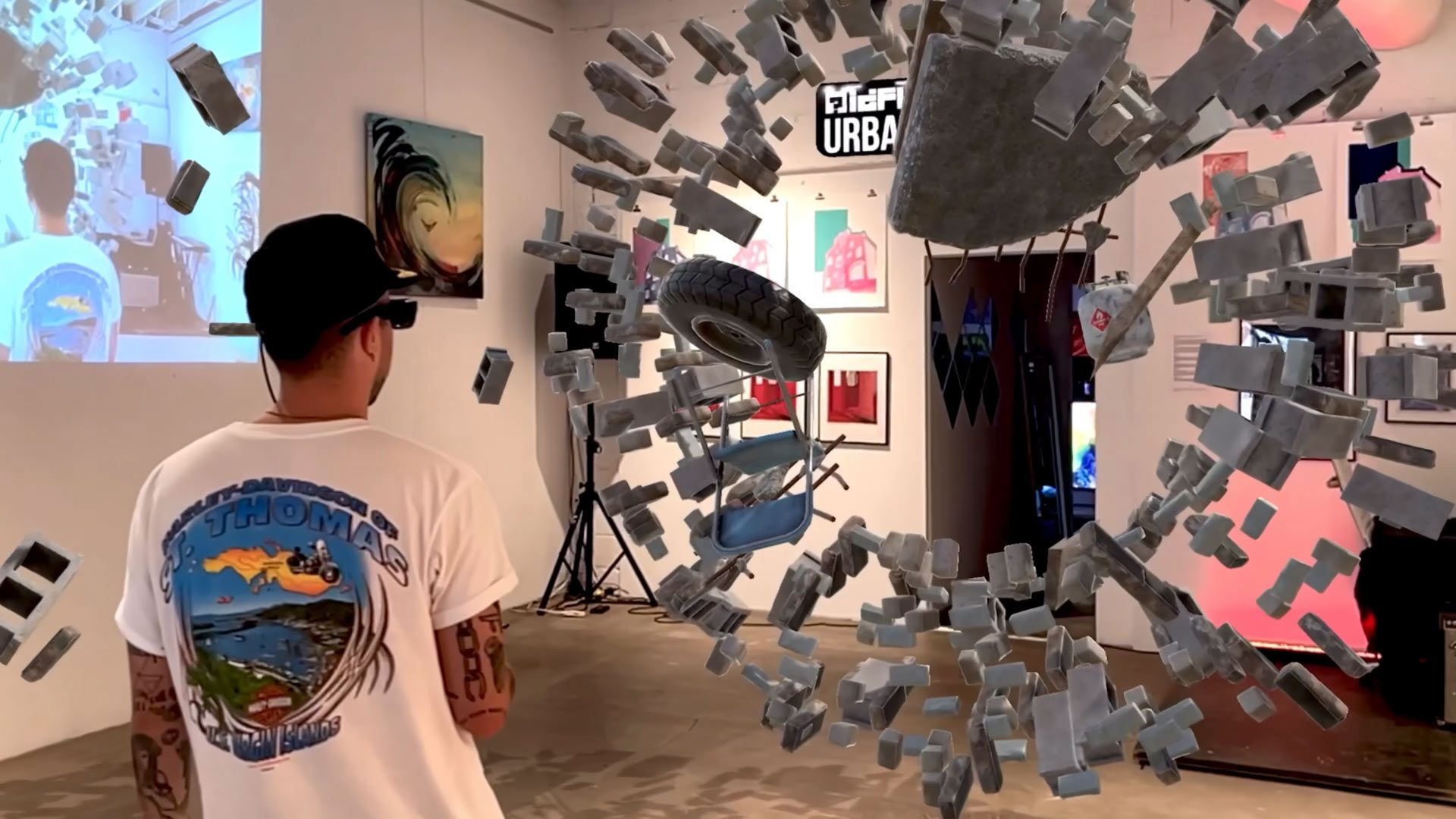
Augmenting Reality’s Middle Class: Trace as the “Canva of AR”
Trace is a no-code augmented reality platform launched by former Magic Leap engineers, positioning itself as the “Canva of AR.” It enables creators and organizations to build AR experiences for mobile and mixed reality devices through drag-and-drop composition, asset libraries, and spatial anchoring without programming. Emerging amid shuttering incumbent tools, Trace targets brand activations, events, and location-based storytelling while courting both enterprise and independent creators.
This case is significant because it reframes AR production from a specialist, code-based craft to an accessible, templated practice. Lowering barriers can expand the creator base, diversify cultural repertoires, and accelerate experimentation. Yet, it also concentrates symbolic power in platform governance, presets, and recommendation layers that quietly standardize aesthetics and interaction norms across the AR ecosystem.
Trace recasts AR creation as modular orchestration rather than engineering, exemplifying digital culture’s “separate and recombine” logic. No-code authoring externalizes expertise into presets, templates, and parameterized operations, enabling a new “prosumer” stratum that assembles experiences from pre-trained capabilities. This redistributes agency: users retain curatorial control while the platform encodes tacit knowledge, shaping outcomes through defaults and constraint sets. As with other predictive and generative tools, this can homogenize styles via convergent affordances, even as combinatorial remix yields apparent diversity. The platform further acts as a cultural intermediary, translating brand narratives into spatial sign systems—anchoring meaning to places, props, and embodied gestures—thereby converting everyday environments into semiotic surfaces. Network effects may privilege platform-native grammars and metrics of engagement, subtly steering creators toward measurable spectacle over situated cultural nuance. Finally, as AR migrates from headsets to mobile and back, Trace sits within an infrastructural competition: whoever owns asset libraries, spatial mapping conventions, and distribution levers can script the future of everyday augmentation.
Practical Implications for Organizations
- Pilot “template-plus” workflows: start with Trace presets, then customize assets and interaction logic to avoid aesthetic sameness.
- Build a brand semiotic system for AR: define spatial anchors, gestures, and object metaphors that consistently encode brand meaning across locations.
- Treat AR like retail merchandising: prototype placement, traffic flow, and dwell-time micro-interactions; A/B test spatial narratives.
- Develop governance for place-based data: establish consent, safety, and accessibility standards for persistent or location-linked content.
- Measure beyond spectacle: track memory lift, path-to-purchase, and community co-creation, not only views and shares.
- Create creator partnerships: cultivate a roster of Trace-native creators; co-develop modular toolkits and reusable components for rapid iteration.
Consumer tribes that may relate to this case study:
 Eureka