Wind-Farmed Seaweed: Regenerating Seas Through Multi-Use Energy Infrastructures
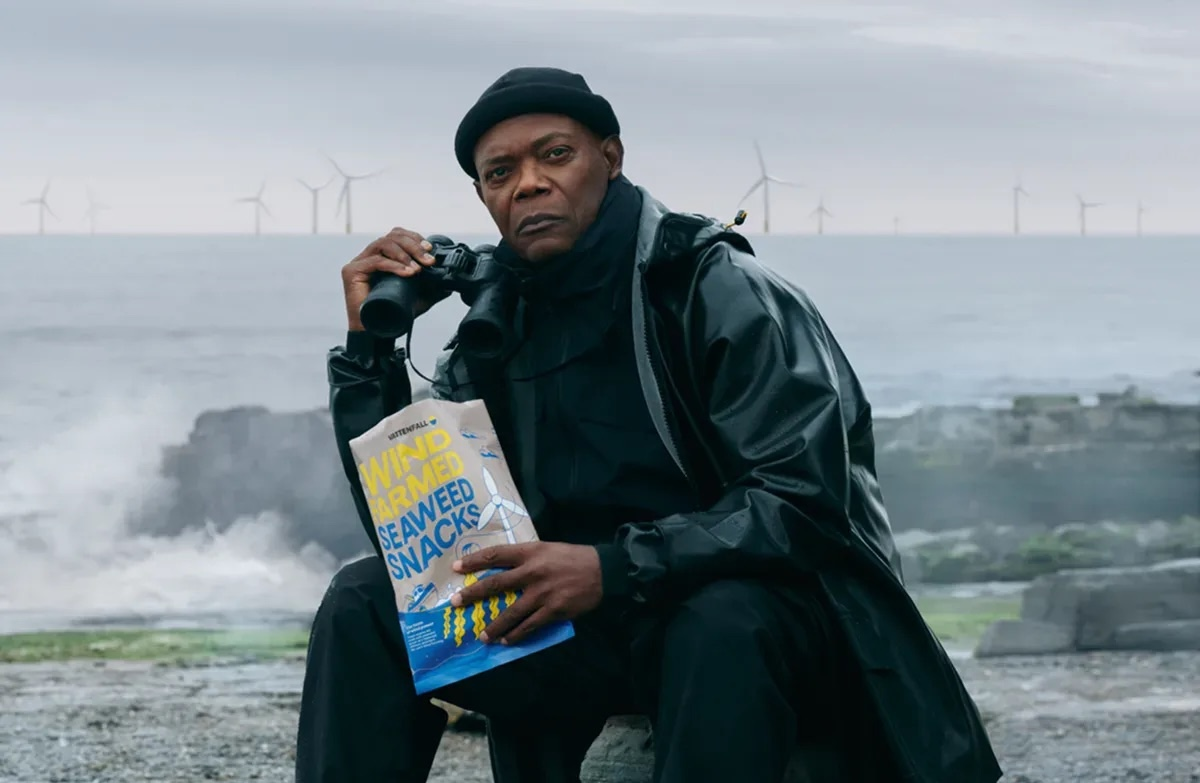
Vattenfall’s “Wind Farmed Seaweed” pilot cultivates seaweed between offshore turbines at Vesterhav Syd and transforms the harvest into Wavy Wonders snacks, distributed as “food for thought.” Positioned within the EU-backed WIN@sea initiative, the project explores multi-use platforms that pair renewable generation with aquaculture. Seaweed lines fixed to turbine foundations were seeded, grown, hand-harvested, dried, and baked, demonstrating how existing energy infrastructure can host low-impact mariculture. The collaboration with Wavy Wonders and storytelling with Samuel Jackson served to make an unfamiliar marine practice tangible and edible.
Beyond a culinary novelty, the project tests co-location as a spatial and ecological optimization of ocean commons. Seaweed absorbs dissolved nutrients and CO₂, mitigating eutrophication and providing habitat complexity. By sharing vessels, crews, and monitoring systems, co-use reduces operational redundancies, potentially lowering costs and emissions while supporting marine recovery. The case stages a future in which electricity and food are co-produced within the same maritime footprint.
This experiment exemplifies infrastructural re-signification: wind farms shift from single-purpose assets to socio-ecological platforms. It reframes public meaning through symbolic consumption, using a snack as a boundary object that translates complex marine science into everyday experience. As a form of blue circularity, the seaweed acts as a biotic sink and a nutritious output, aligning metabolic flows with regenerative aims. The initiative also illustrates algorithmic governance in marine space: sensor data, permits, and maintenance scheduling coordinate heterogeneous actors, requiring interoperability and risk management. Brand semiotics are central—the term “Wind Farmed” fuses industrial modernity with craft food ethics, softening contested seascape imaginaries and inviting stakeholder legitimacy. From a consumer culture perspective, the edible proof-of-concept constructs an anticipatory marketplace, pre-qualifying demand while signaling stewardship. Nevertheless, co-use introduces boundary tensions: biofouling risks, navigational safety, liability, and the politics of access among fishers, energy firms, and regulators. The value proposition thus hinges on demonstrable ecological gains, robust safety protocols, and equitable benefit-sharing. Scaling requires standardization but must avoid erasing local ecologies and livelihoods that make the model credible.
Practical Implications for Organizations
- Design for multi-use from the outset: embed aquaculture-ready fixtures, shared access corridors, and data ports in turbine and substation specifications.
- Operationalize blue circularity KPIs: track nutrient uptake, biodiversity proxies, and co-use fuel savings alongside LCOE to evidence net-positive impact.
- Build boundary objects for legitimacy: create tangible artifacts (e.g., limited snack runs) that translate technical outcomes into sensory proof for stakeholders.
- Co-govern with local users: formalize revenue-sharing, harvest quotas, and joint safety protocols with fishers and coastal communities to reduce conflict.
- De-risk with modular pilots: deploy small, monitor intensively, iterate husbandry methods, then codify SOPs for port, vessel, and maintenance integration.
- Align brand narratives with governance: make sure to pair regeneration claims with transparent data dashboards to prevent reputational greenwashing.
Consumer tribes that may relate to this Eureka:
 Eureka
 Eureka