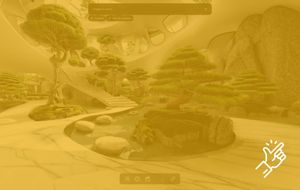
Marble and the Cultural Imagination of Generated Worlds
Marble by World Labs is a multimodal world model that synthesizes persistent, explorable 3D environments from text, images, video, or coarse layouts and allows users to iteratively edit and expand them. Instead of generating isolated images or short video clips, Marble produces navigable spaces with coherent geometry and depth, enabling both humans and AI agents to inhabit, simulate, and reconfigure these virtual worlds. Through a browser-based interface, users can “lift” familiar 2D media into volumetric scenes, blend heterogeneous aesthetic inputs, and compose larger worlds from modular fragments.
Beyond its technical achievement, Marble signals an important cultural shift in how environments, identities, and futures are authored. It operationalizes “spatial intelligence” as a consumer-facing capability, redistributing skills historically tied to specialized game engines, CGI studios, and simulation labs. World-making becomes a form of everyday digital practice: brands, creators, and institutions can rapidly materialize fictional universes, speculative architectures, or data-driven simulations. In doing so, Marble participates in a broader reconfiguration of power over who designs spaces and how social imaginaries are rendered, circulated, and monetized.
Marble exemplifies the move from representational media to predictive, generative infrastructures that assemble 3D space from statistical regularities in training data. Its outputs are not neutral containers but encoded with sedimented norms about interiors, bodies, mobility, and “plausible” environments. The system’s ability to interpolate among cartoonish, photorealistic, and hybrid aesthetics foregrounds the modular logic of contemporary digital culture: shapes, textures, lighting schemes, and architectural typologies are discretized as “culture atoms” that can be recombined on demand. This modularity promises creative freedom yet risks reproducing stereotypical world templates, especially where training data overrepresents dominant geographies, lifestyles, and design languages. As a world model, Marble also functions as an infrastructure for synthetic ethnography: the spaces it generates become stages where user behavior, agent navigation, and interaction patterns can be observed and optimized. In this sense, it simultaneously produces environments and governs possible actions within them. The platform thus sits at the intersection of consumer culture, platform capitalism, and algorithmic governance, transforming 3D space into a programmable medium for affect, persuasion, and prediction.
Practical Implications for Organizations
- Use Marble to prototype brand “worlds” that express symbolic values spatially, then test how different groups navigate and interpret these environments.
- Treat generated spaces as semiotic surfaces: audit objects, lighting, and spatial hierarchies for unintended classed, gendered, or racialized cues.
- Build internal guidelines for “world diversity,” specifying underrepresented architectures, geographies, and vernacular styles that should be deliberately included.
- Integrate Marble into customer research by observing how users modify and extend brand-created spaces, reading edits as feedback on desired identities and futures.
- For robotics, retail, or mobility, simulate scenarios across multiple generated layouts to stress-test wayfinding, accessibility, and safety logics.
- Negotiate data and IP governance early: clarify ownership of co-created worlds, logs of in-world behavior, and derivative training rights.
Consumer tribes that may relate to this case study: