
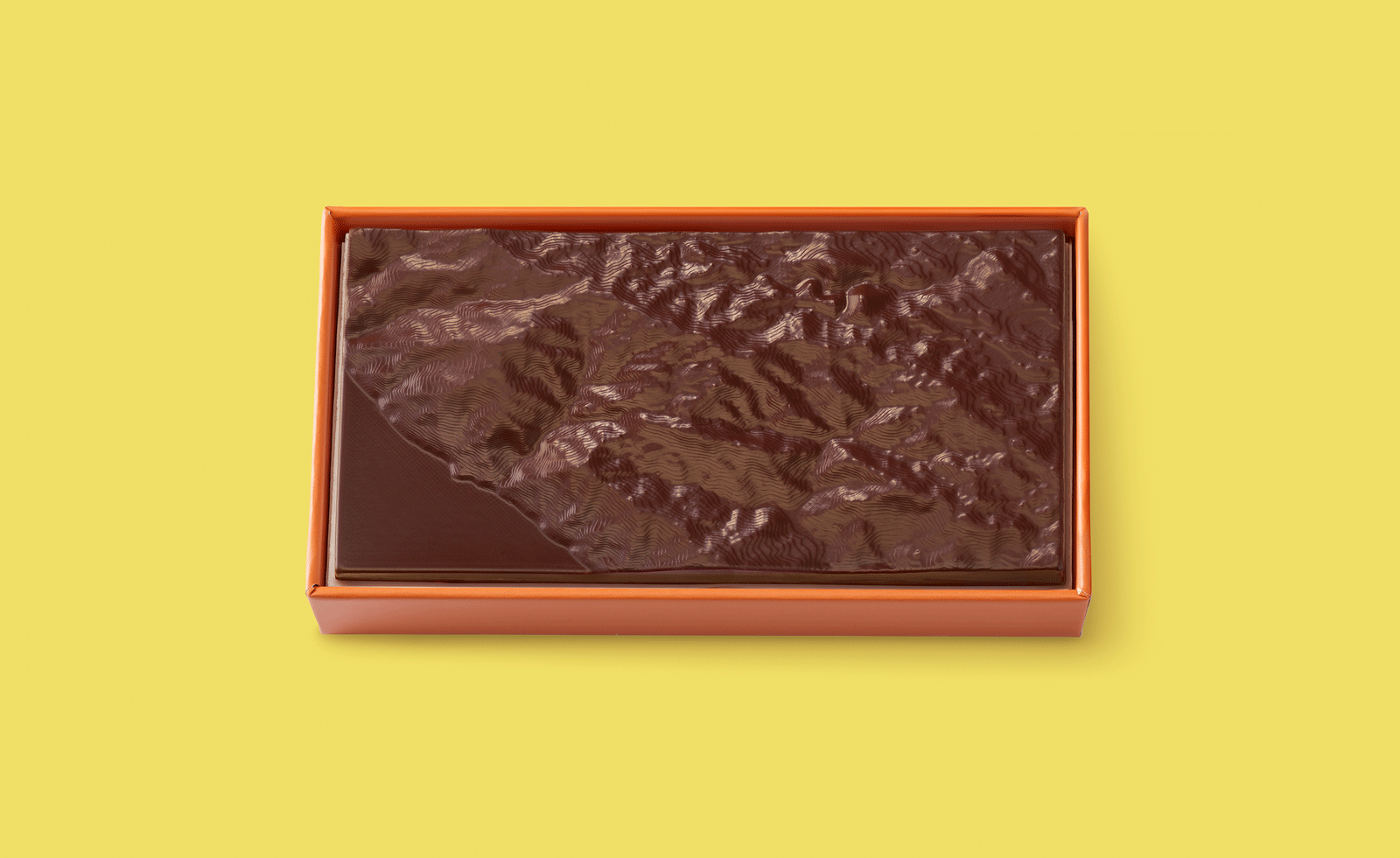
Ed Ruscha’s “Made in California”: Luxury Chocolate as Conceptual Artwork
The case concerns the collaboration between Ed Ruscha and andSons Chocolatiers on a limited-edition “Made in California” chocolate bar. Produced in a run of only a few hundred pieces and priced as a luxury collectible, the bar is presented in highly designed packaging that foregrounds Ruscha’s signature California vernacular. The chocolate itself is infused with West Coast ingredients, while the object is framed as both a confection and signed art multiple, circulating through art news media as much as food and lifestyle channels.
Beyond a novelty gift, this collaboration exemplifies how contemporary art brands extend into edible, ephemeral formats while retaining scarcity, authorship, and aura. It amplifies the long-standing entanglement of pop art, mass culture, and commerce, but now within a digitally mediatized consumer culture in which images of the bar likely travel further than the bar itself. The case illuminates how luxury food, art-world prestige, and Californian mythologies intersect to produce new kinds of “edible capital.”
The chocolate bar can be read as a ready-made updated for the age of influencer culture: an everyday commodity upgraded through the attachment of an art-world signifier. The bar’s value does not derive from material quality alone but from semiotic layering—California nostalgia, pop-art heritage, and the exclusivity of a numbered edition. This produces a liminal artifact that is simultaneously a consumable good and a collectible asset, foregrounding tensions between use value (eating) and sign value (displaying, posting, reselling).
From a consumer culture perspective, the collaboration mobilizes desire structures around indulgence, self-gifting, and mood regulation linked to chocolate, while reframing these effects through high-art legitimation. Socially, the object functions as a status-bearing token in cultural capital games: owning or gifting the bar signals access to both fine art and gourmet micro-luxury. Digitally, the photogenic design anticipates circulation on visual platforms, where the bar operates as a “shareable artifact” that extends both brands’ symbolic reach. Ultimately, the case shows how contemporary brands orchestrate multi-sensory, cross-media experiences that blur art, gastronomy, and lifestyle into a single narrative of curated sophistication.
Practical Implications for Organizations
- Use artist collaborations to convert ordinary products into symbolic luxury, emphasizing narrative and authorship over pure functionality.
- Design artifacts with “dual life” in mind: materially satisfying but also optimized for visual circulation on social platforms.
- Employ scarcity, numbering, and limited runs to create collectible status while monitoring secondary-market dynamics.
- Align collaborations with strong place-based mythologies (e.g., “California”) to anchor abstract luxury in culturally resonant geographies.
- Integrate cross-channel storytelling so PR, packaging, retail, and social media all reinforce the same conceptual frame.
- Treat edible or ephemeral objects as portals into longer-term brand relationships (membership, archives, future drops).
Consumer tribes that may relate to this case study:
 Eureka
 Eureka