Everdrone’s AED Drone Network in Normandy: Algorithmic Care in the Sky
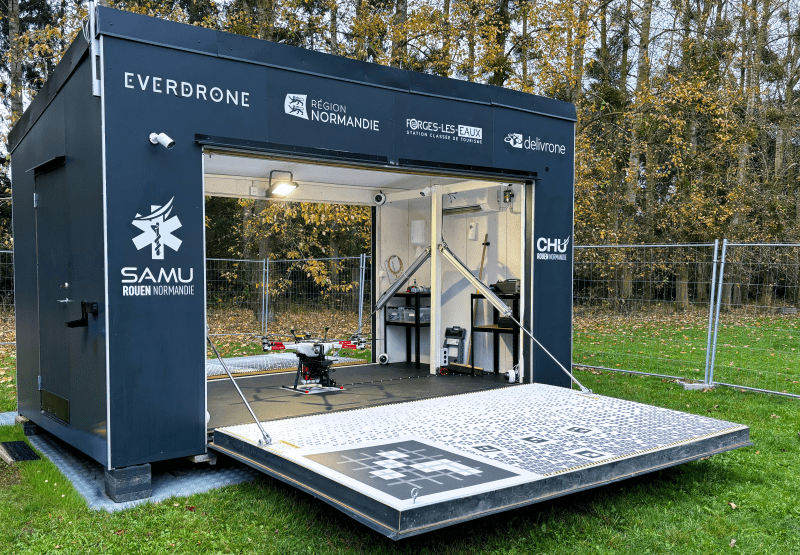
Everdrone’s deployment of an automated external defibrillator (AED) delivery drone service in Normandy marks a significant step in the algorithmic reconfiguration of emergency medicine. The service integrates drone dispatch into the existing emergency call chain so that when suspected cardiac arrest cases are reported, drones carrying AEDs can be routed to the scene in parallel with, or ahead of, ambulances. Normandy becomes a testbed where local emergency infrastructures, airspace regulators, and a specialist drone firm coordinate to produce a semi-autonomous life-saving network that fuses logistics, robotics, and telemedicine.
Beyond its technical novelty, the Normandy case crystallizes wider shifts in how societies imagine and enact care through data-driven systems. It exemplifies a move from territorially fixed infrastructures (ambulance depots, hospitals) to distributed “aerial” infrastructures in which algorithmic triage, geolocation, and route optimization orchestrate responses to cardiac risk. The Everdrone initiative also performs a symbolic function: it materializes a promise that advanced technologies will close gaps in rural and peri-urban healthcare, while simultaneously introducing new dependencies on proprietary platforms, sensor networks, and regulatory frameworks.
Viewed through digital anthropology and critical data studies, the service can be read as an emergent “digital twin” of the emergency landscape, where real-time data on incidents, weather, and flight paths model possible futures and guide intervention. Algorithmic decision chains do not eliminate human discretion; rather, they redistribute it across call-center operators, medical protocols, drone operators, and software engineers whose assumptions are encoded in dispatch rules and risk-scoring thresholds. From a consumer culture perspective, the AED drone also becomes a powerful brand object for Everdrone and institutional partners: a flying signifier of innovation that reframes public expectations about what “good” emergency care should look like and how quickly it should arrive. Yet, underlying these imaginaries are questions of access, accountability, and uneven benefit. Rural populations may be positioned both as beneficiaries and as experimental subjects in a living laboratory of aerial health logistics. The case thus exposes tensions between public value narratives and the commercial logics of platformized emergency services, with implications for trust, consent, and perceptions of state responsibility in technologically mediated care.
Practical Implications for Organizations
- Integrate drone services into existing emergency workflows as socio-technical systems, co-designing protocols with dispatchers, clinicians, and local communities.
- Treat real-time operational data as both clinical infrastructure and cultural resource, using it to audit equity of coverage, not only speed and efficiency.
- Anticipate “innovation theater”: align symbolic demonstrations of drone capability with transparent metrics on health outcomes and service accessibility.
- Develop clear accountability chains for algorithmic dispatch decisions, including human override procedures and explainable criteria for prioritization.
- Engage in participatory communication strategies that frame drones as complements to, not replacements for, human care providers, preserving trust.
- Plan for scalability by designing modular governance, insurance, and data-sharing frameworks that can travel across regions without eroding local oversight.
Consumer tribes that may relate to this case study:
 Eureka