
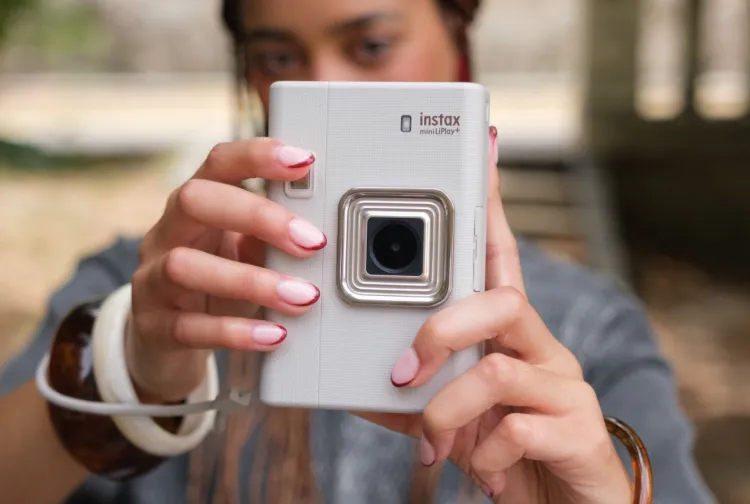
Fujifilm’s Instax Mini LiPlay Plus: Instant Photography in the Algorithmic Selfie Age
Fujifilm’s Instax Mini LiPlay Plus is a hybrid instant-digital camera designed to synchronize the nostalgic pleasures of instant film with the contemporary logics of the selfie. Building on an earlier model, it now incorporates dual cameras—a front-facing main lens and a rear wide-angle selfie camera—along with smartphone connectivity and creative modes. The device bridges physical Instax prints, on-camera capture, and mobile remixing, positioning itself as a portable, playful interface between embodied sociality and platform-oriented image circulation.
Beyond product innovation, the Instax Mini LiPlay Plus materializes wider transformations in visual culture. It responds to a world where self-presentation is continuous, algorithmically curated, and governed by metrics such as likes and shares. By embedding selfie affordances directly into an instant camera, Fujifilm reconfigures instant photography from a predominantly co-present, intimate practice into a node in networked, datafied identity performances.
The camera exemplifies the convergence of prosumption and self-branding. Users are invited to be both creators and curators of their image streams, transforming everyday life into stylized, shareable content. The hybrid architecture—simultaneously analogue and digital—performs a semiotic negotiation between authenticity and artifice: tangible film prints connote warmth, nostalgia, and “realness,” while digital overlays, filters, and smartphone integration signal fluency in contemporary platform vernaculars. This assemblage aligns with the broader shift from mass media spectatorship to participatory visual production, where users reproduce themselves and their relationships through iterative visual practices.
The Instax Mini LiPlay Plus also reconfigures social interactions. Instant prints act as micro-gifts, material tokens of recognition within friendship, fandom, or brand communities, while the selfie camera encourages tightly framed, face-centric compositions centered on the expressive self. Such devices extend “media of the self,” in which identity is enacted through serial visual updates, often optimized for future algorithmic visibility. For brands, this indicates that consumer value no longer rests only in product ownership but in the capacity of products to become props and stages for ongoing narrative performances across platforms.
Practical Implications for Organizations
- Design products as “stages” for self-presentation, prioritizing affordances that make users look and feel expressive, playful, and socially shareable.
- Combine analogue or tactile elements with digital connectivity to signal authenticity while remaining compatible with platform logics and metrics.
- Treat users as co-producers of brand meaning; build features that invite remixing, layering, and personalization of branded content.
- Leverage products as social tokens: emphasize giftability, co-presence, and small rituals (e.g., instant prints exchanged at events).
- Align product semiotics with contemporary visual vernaculars (selfies, filters, stickers), while differentiating through distinctive aesthetic codes.
- Integrate data-aware design that respects privacy but recognizes that visibility, measurability, and shareability now drive adoption and advocacy.
Consumer tribes that may relate to this case study:
 Eureka
 Eureka
 Eureka