
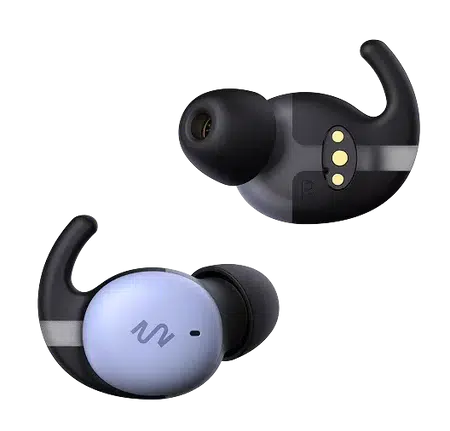
Brain-Responsive Wearables: How NextSense Smartbuds Redefine the Quantified Self Through Active Neurological Intervention
NextSense Smartbuds represent a significant departure from conventional sleep-tracking wearables. Founded by a former researcher at Alphabet's X lab, NextSense developed the first truly wireless earbuds equipped with six clinical-grade electroencephalography sensors capable of measuring brain activity in real time. Weighing only five grams, the Smartbuds detect transitions between light sleep, deep sleep, and wakefulness at millisecond resolution, then respond with precisely timed pink noise pulses synchronized to the brain's slow-wave rhythms. Priced at $249 and supported by a recurring Fit Kit subscription that delivers fresh ear tips and conductive wings to maintain EEG signal integrity, the product merges consumer audio with neuroscience-grade biometric monitoring.
The broader significance of this case lies in its pivot from passive datafication to active, closed-loop intervention. Where most wearables merely quantify bodily states, NextSense Smartbuds act upon them, positioning brain health alongside heart rate and step counts as an accessible, actionable metric. This reframing challenges prevailing models of sousveillance and the quantified self by introducing a feedback mechanism that transforms personal data into immediate physiological benefit.
NextSense Smartbuds illustrate a maturation in consumer biometric culture. Traditional self-tracking devices operate within a paradigm of sousveillance, rendering bodily data legible but leaving interpretation and action to the user. Smartbuds collapse this gap through a cybernetic loop: sensors capture neural signals, algorithmic processing classifies sleep stages, and audio stimulation modulates brainwave architecture in real time. This closed-loop design embodies the concept of the extended mind, wherein cognition and recovery are distributed across biological and technological substrates. Furthermore, the subscription model for physical consumables introduces a novel materiality into digital health ecosystems, binding sustained data quality to ongoing commodity exchange. The dataset of over one thousand nights of in-ear EEG data also raises questions central to critical data studies: who governs this intimate neural data, and how might accumulation at scale enable algorithmic profiling of cognitive states? The shift from inferring sleep through proxy metrics to directly measuring electrical brain activity marks an epistemological transition comparable to the move from surveys to sensors in datafication scholarship.
Practical Implications for Organizations
- Explore closed-loop product architectures that convert real-time biometric data into immediate user benefit, moving beyond passive dashboards.
- Design subscription models around physical consumable renewal to sustain sensor accuracy and create predictable revenue.
- Invest in transparent neural-data governance frameworks to build consumer trust around intimate biometric information.
- Communicate product value through clinical-grade language to differentiate from commoditized wellness trackers.
- Leverage proprietary datasets ethically to refine algorithmic personalization while establishing clear data-use policies.
Consumer tribes that may relate to this Eureka:
 Eureka