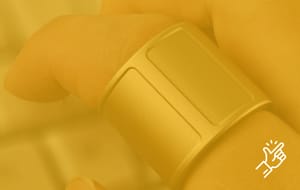
Finger as Interface: The Prolo Ring and the Promise of Ambient Precision
The case examines the Prolo Ring, a wearable computer mouse featuring a thumb-operated trackpad and motion sensing that allows users to control computers, smartphones, TVs, and other devices via finger-based gestures. Emerging from the convergence of miniaturized sensors and low-latency wireless protocols, the device reframes cursor control as a subtle hand micro-ritual rather than a desktop-bound action. It translates embodied movement into precise input, extending the interaction surface from screen and desk to the body itself.
Beyond a novel gadget, the Prolo Ring signals a shift toward ambient, peripheral interfaces that dissolve into everyday practices. By abstracting “point-click-scroll” into a portable micro-gesture grammar, it redistributes agency across human and machine in more continuous ways. The device’s promise lies not just in convenience, but in how it reconfigures attention, ergonomics, and social signaling in multi-device ecologies.
As a body-worn interface, the ring functions as a portable locus of symbolic control, relocating input from the stable plane of the desktop to the dynamic, lived body. This re-siting alters the phenomenology of interaction: the finger becomes a semiotic vector, where micromovements stand in for commands, and tactility mediates cognition. Such displacement foregrounds procedural literacy in gesture—users must acquire a kinesthetic repertoire—while promising reduced cognitive friction once habituation stabilizes. The ring exemplifies spatiotemporal layering in interaction: motion sensing (continuous time) complements discrete tap zones (spatially segmented), together producing a fluid hybrid grammar. It also surfaces the politics of visibility: unlike overt controllers, a subtle ring risks a blur between intentional commands and incidental movement, demanding robust thresholds and context-awareness to avoid misfires. In consumer culture terms, the wearable form renders control conspicuous yet minimal, aligning with aesthetic logics of discreteness and premium craft that index status through restraint. Algorithmically, the device encodes normative hand postures and movement envelopes; these defaults may privilege certain bodies and contexts, raising inclusion and accessibility stakes. Finally, as an object in a platform assemblage, its value hinges on interoperability and latency discipline across operating systems and screens, where even minor lag can rupture the sensory loop and trust.
Practical Implications for Organizations
- Treat the body as interface: invest in gesture taxonomies, haptic feedback, and error thresholds that respect situated use and reduce false positives.
- Design for habituation curves: provide progressive disclosure, adaptive sensitivity, and micro-tutorials that scaffold kinesthetic learning.
- Prioritize latency budgets: set end-to-end performance targets where round-trip delays remain below perceptual breakpoints in cursor control.
- Build cross-device continuity: ensure seamless switching across laptops, phones, and TVs with consistent gesture semantics and state memory.
- Address inclusivity early: test with diverse hand sizes, mobility ranges, and wear contexts; expose calibration profiles rather than single “universal” defaults.
- Anticipate social signaling: enable “do not disturb” and subtle-mode cues to mitigate ambiguity in public and collaborative environments.
- Harden privacy by design: keep motion data on-device where feasible; make data flows legible and user-governable.
- Craft modular ecosystems: publish SDKs for third-party gestures and app-specific mappings to unlock niche, high-value workflows.
Consumer tribes that may relate to this case study: