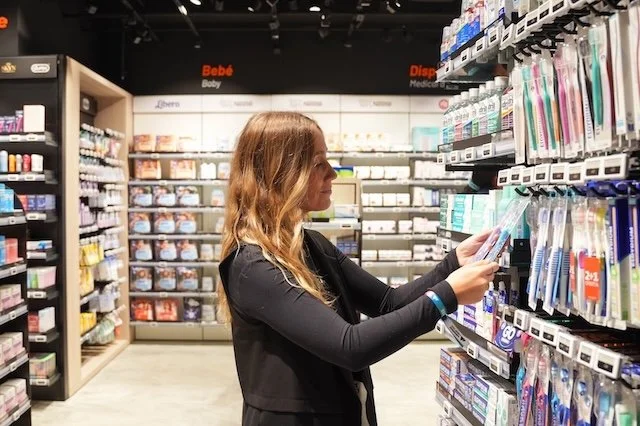
Sensei’s Autonomous Pharma&Go: Re-Coding the Pharmacy Servicescape
Located in Parque das Nações, Lisbon, the autonomous Pharma&Go store, powered by Sensei, combines a compact grab-and-go layout with computer vision and AI-driven stock management to deliver a fully automated healthcare retail experience. Operating continuously within a small footprint, it allows consumers to enter, select products, and leave without conventional checkout, while staff are repositioned toward replenishment and occasional advisory roles. The store extends the logic of convenience retail into health-related products, promising frictionless access and data-optimized operations.
Beyond operational novelty, Pharma&Go signals a semiotic and cultural shift in how healthcare commodities, pharmaceutical expertise, and algorithmic governance intersect. By embedding medicalized products in an always-on, staff-light “smart” servicescape, the store reconfigures norms of trust, care, surveillance, and autonomy in everyday health management. It condenses pharmacy, vending machine, and data platform into a single hybrid environment.
The servicescape can be read as a move from a traditional proscenium pharmacy model—counter, queue, pharmacist as authority—to a “flat” algorithmic space where spatial hierarchies are softened and the interface shifts to sensors, cameras, and apps. This transformation redistributes agency: consumers gain temporal and spatial flexibility but become increasingly dependent on opaque computational systems that curate assortment, optimize flows, and generate behavioral data. Healthcare consumption becomes a performance co-authored by bodies, merchandise, and machine vision.
Pharma&Go also exemplifies the migration of autonomous retail from low-stakes grocery into symbolically charged health categories. Here, the semiotics of cleanliness, efficiency, and neutrality mask intensified monitoring and data extraction. The absence of visible staff does not simply reduce labor but rearticulates care as infrastructure rather than relationship. Trust, once anchored in embodied professional expertise, is reinscribed in technical reliability, brand reputation, and ambient security aesthetics. At the same time, the store functions as a cultural laboratory for “self-care on demand,” normalizing the idea that pharmaceutical products should be as instantly accessible as snacks, blurring lines between medical necessity, lifestyle optimization, and impulse purchase.
Practical Implications for Organizations
- Design autonomous formats as coherent narratives of safety, care, and efficiency, not just as technical deployments.
- Reposition staff into visible “care nodes” (pop-up consult points, telepharmacy hubs) that complement automation rather than disappearing entirely.
- Use real-time data ethically to adapt the assortment and layout while clearly communicating how health-related data are collected and protected.
- Develop semiotic guidelines for lighting, color, signage, and sound that express medical credibility without reproducing cold, clinical atmospheres.
- Prototype hybrid access models (membership, age-gated zones, prescription lockers) to manage regulatory and ethical sensitivity around health products.
- Measure success not only through throughput and shrinkage but through perceived trust, intelligibility of the system, and inclusiveness for non-digital or vulnerable users.
Consumer tribes that may relate to this case study:
 Eureka