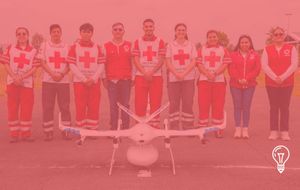
Wingcopter x Sincronía Logística: Dronifying Humanitarian Pharmalogistics
Wingcopter partnered with Sincronía Logística to deliver medicines and medical equipment for Cruz Roja Mexicana using the Wingcopter 198 over an eight-kilometre route. Following a demonstration in Querétaro, Sincronía Logística secured all required permits and will operate a fleet to add an aerial layer to high-value pharmaceutical logistics. The collaboration aims to accelerate first responder access to remote communities where terrain and infrastructure impede road transport. Insights from the Mexican deployment will also inform Wingcopter’s planned medical delivery initiative in Costa Rica.
This case is significant because it reframes humanitarian logistics as a socio-technical assemblage where drones, regulators, operators, and caregivers co-produce value-in-use. It illustrates how aviation-grade automation can extend care infrastructures, not by replacing roads, but by reconfiguring last-mile temporalities, reliability, and trust. It also surfaces ethical, cultural, and governance questions around data practices, accountability, and the social license to operate in crisis-adjacent contexts.
The collaboration can be read as a shift from static supply chains to responsive “aeromesh” networks that compress distance through algorithmically coordinated flight operations. Drones act as symbolic carriers of modernity and neutrality, recoding the brand meanings of both Wingcopter and Sincronía Logística from logistics vendors into caregivers at altitude. Humanitarian legitimacy functions as cultural capital that mitigates risk perceptions and eases institutional adoption. The servicescape extends beyond physical depots into air corridors and apps, where tracking, ETA signals, and audit trails produce calculable assurances. However, data imaginaries—beliefs about what flight telemetry and delivery records can reveal—shape expectations and responsibilities. Frictions remain: interoperability with health facilities, equitable access in marginalised communities, and the politics of airspace where sovereignty, safety, and commercial incentives intersect. The case exemplifies infrastructural inversion: by spotlighting permitting, flight corridors, and handover protocols, it reveals that the social infrastructure—agreements, training, and accountability—determines whether technical performance translates into public value.
Practical Implications for Organizations
- Build a humanitarian-tier operating model: codify SOPs for cold-chain, chain-of-custody, and crisis escalation mapped to drone mission profiles.
- Treat air corridors as brand touchpoints: design transparent tracking, proof-of-delivery, and incident communication to cultivate trust.
- Start with route minimalism: pilot short, repeatable lanes to stabilise reliability metrics before scaling to hub-and-spoke or mesh configurations.
- Co-govern with local institutions: embed MOUs with health agencies and first responders; align KPIs with care outcomes, not just flight counts.
- Anticipate data governance: define retention, sharing, and consent for telemetry and delivery data; minimise datafication of patients.
- Integrate workforce hybridity: train pharmacy, dispatch, and field staff in drone handoffs; redesign roles to reduce bottlenecks at pickup and drop-off.
- Engineer for terrain realities: standardise payload packaging and recovery protocols for rugged landing zones and adverse weather contingencies.
- Stage regulatory readiness: maintain a living dossier of airworthiness, risk assessments, and incident logs to expedite new routes and markets.
Consumer tribes that may relate to this case study: